IGWE KENNETH NNAJI ONYEMAEKE ORIZU III
Obi of Nnewi
Nigeria
When Kenneth Nnaji became King of Nnewi in 1963, he was a farmer, and his ten wives had already blessed him with thirty children.
Located to the east of the Niger river, in Ibo country, Nnewi is a rich town with several millionaires. This kingdom, founded in the fourteenth century, is composed of four large villages.
When the Portugueses arrived in the region in the fifteenth century, a multitude of city-states appeared.
As with Nnewi, these cities were built on the basis of a thriving slave trade. Born with the trade, they lived only for trade, and did not look favorably upon the creation of a state uniting under the same Nigerian flag, the Ibo, the Yoruba and the Hausa. Ethnic and religious clashs erupted, starting the Biafra War.

HAPI IV
King of Bana
Cameroun
The kingdom of Bana finds its origins in a tragedy.
In the middle of the twelfth century, several Bamileke groups, settled in small villages around what is actually Bana. Legend says that one of the village chiefs, Mfenge was accused of sorcery by the others. In order to exonerate himself, he cut off his mother’s head and had the cadaver examined by specialists. The belief in sorcery, that it is transmitted through the “maternal womb”, was not proven. Mfenge then demanded that mothers in others families be beheaded. His four sons went from house to house, sending wives and mothers to the palace, in order to be examined. The recalcitrants were decapited on the spot. Taken by panic, chiefs and nobles fled, and Mfenge became King of Bana.

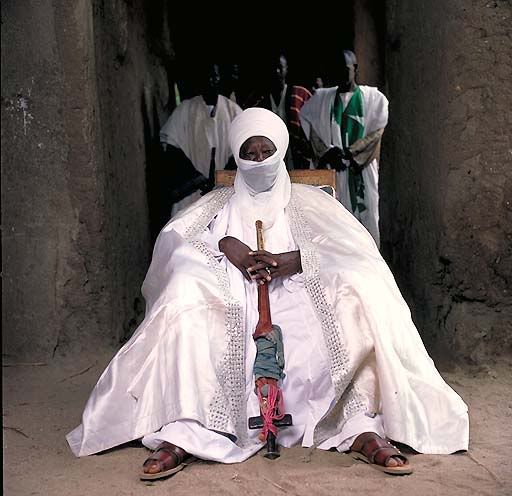
ABUBAKAR SIDIQ
Sultan of Sokoto
Nigeria
This photo was taken fifteen days before the death of the Sultan of Sokoto. He had reigned for more than fifty years. At the time of his successor’s coronation, who was chosen by a council of “king makers”, a conflict erupted. Two royal families disputed the choice; the consequence: one hundred deaths.
According to “news watch”, a large daily Nigerian newspaper, the power of the Sultan of Sokoto is such, that most of the Nigerians questioned would rather be Sultan than President of Nigeria.
Abubakar Sidiq was not as rich as other soverains of this country. He earned annually about 1 million naira ($200 000). But with this income, the Sultan had to support his suite of eighty-six people, and feed one hundred and fifty grand children.

OSEADEEYO ADDO DANKWA III
King of Akropong-Akuapem
Ghana
A graduate from the University of London and an economic advisor for the Ghanaian administration, The King of Akropong holds for the last sixteen years the “sacred seat” of the Akuapem-Asona, one of the seven major Akan clans. To his right, his “spokesman” carries the royal emblem, the elephant, a remembrance that his kingdom was founded by force.

HALIDOU SALI
Lamido of Bibemi
Cameroun
Halidou Sali, the twelfth Lamido (king) of Bibemi, received his kingdom in 1958. He is a descendant of Aido Samba, one of the 42 Kings of Adamawa, who during the eighteenth century carried the flag for the Jihad (holy war) of Ousman Dan Fodio.

NGIE KAMGA JOSEPH
Fon of Bandjun
Cameroun
The Fon (King) is the brother of courageous and powerful animals. At night, he has the power to transform himself into a panther, where he haunts the forest, runs through the savana and drinks from torrents. When a panther is killed by a hunter, the Fon from Bamileke region are afraid. Will one of them not perish from the death of his double.
Formerly a chief administator and cabinet chief for the finance Minister of Cameroun in 1964, Kamga Joseph is the thirteenth Fon of Bandjun. On the day of his predecessor’s funeral, he was stopped in the Bandjun market by two Bamileke chiefs, “the hangmen”, in the middle of the nobles and princes who wept the deceased King. Wearing a head dress made of sisal as a sign of humility, he was taken to the noblemen, the “tafo meru”, where he learned during nine weeks how to be a King.

ISIENWENRO JAMES IYOHA INNEH
Ekegbian of Bénin
Nigeria
James Inneh, seventy nine years old, was formerly a business man.
In 1962, he was named commander of the royal guards, “isienwenro”, by the king Akenzua. “Asako no s’oghionba” (ants sting the King’s enemies), was how the royal guards responsible for the King’s security, were called.
During some rituals, they glide around the soverain, completely envelopping him like an army of ants.

EL HADJ SEIDOU NJIMOLUH NJOYA
Sultan of Fumban and Mfon of the Bamun
Cameroun
Eighty years old, the sultan Njoya has been on the throne for more than fifty years.
At the age of twenty nine, he inherited the famous Bamun throne , founded in the sixteenth century. He was chosen, by the kingdom’s council of wisemen, among one hundred and seventy seven of his father’s children , the famous Sultan Njoya.
His father, an enlightened soverain, spent twelve years to invent his own alphabet, made of eighty symbols. He wanted to be able to write in the Bamun language the kingdom’s history. At this time, the oral tradition dominated.
In 1913, while Cameroun was still a German colony, Sultan Njoya equiped himself with his own printing house.

AGBOLI-AGBO DEDJLANI
King of Abomey
Benin
Dedjlani, a former policeman, waited six years to retire, and then proceeded with his secret coronation ceremonies.
“Officially”, there is no longer a king in Benin. But on september 30, 1989, Dedjlani put on his royal shoes, and at the age of fifty four became King of Abomey.
Being monogamous, he was obliged to marry two more wives to take care of his royal household. When he goes out, tradition requires that he be sheltered under an umbrella with his emblem. One of wives must always be next to him, carrying the royal spitting bowl. The King also has to wear his scepter in permanence. Holding it in his hand or hanging on his shoulder, more than a symbol, the scepter is the King.
The silver dust protector worn on the nose, dates from the nineteenth century, and was inherited from the King Gbehanzin. It protected the King’s nose from the dust, during the royal processions in Abomey.

GOODWILL ZWELETHINI
King of Zulu
South Africa
King Goodwill Zwelethini is a descendant of the famous Shaka, founder of the Zulu kingdom.
At the beginning of the ninetheenth century, Shaka was the chief of a small insignificant clan among the Bantu people. Thinking that the survival of the Zulus depended inevitably on the subservience of the other clans, Shaka submitted the natal region to blood and fire. Between 1815 and 1828, he annihilated all tribes that were opposed to him. This troubled period referred to as Mfecan (terror), was accompanied by famine and exodus of a large part of the Bantu population. Shaka’s cruelty became legendary.

EL HADJ MAMADOU KABIR USMAN
Emir of Katsina
Nigeria
The Emir of Katsina is a passionate follower of polo, and his family has contributed many champions to Nigeria.
In the twelfth century, Katsina was a Hausa village, governed by the Durbawa, which was a royal dynasty that had emigrated from a region whose name tradition has lost. One of the Durbawa kings, Janzawa, married a Daura princess from another Hausa state. The Queen Katsina, gave her name to the village which became the terminal of the commercial transsaharien route from Tripoli (Lybia).

SALOMON IGBINOGHODUA
Oba Erediauwa of Bénin
Nigeria
On march 23, 1979, prince Salomon, a graduate of Cambridge University, was crowned Oba (king) of Benin. He suceeded his father Akenzua II, and became the thirty-eigth king of a dynasty dating back to the thirteenth century.
“The large chalk stick is broken”, was the metaphor used to officially announce the death of Akenzua. Immediately afterwards, the Edo of Nigeria, England and America, shaved their heads. The new growth of the hair signified the rebirth of the kingdom, and the re-establishment of the harmony between man and the elements, that had been broken for an instant by the death.

BOUBA ABDOULAYE
Sultan of Rey-Bouba
Cameroun
The Baba (sultan) of Rey-Bouba rules over fifty five thousand subjects, and his territory is as large as Belgium and Luxemburg reunited (35 000Km2).
It is wrong to call him Lamido, because he was never a vassal to Sokoto.
A former parliamentarien in the Camerounian Assembly, Bouba Abdoulaye had to leave everything and renounce modern life in order to suceed his father. His great-grand father, Bouba Ndjidda came from Mali in 1799, with his Fulani warriors, and decided to settle on the borders of Adamawa, at the edge of the Mayo-Rey river. He placed a white flag, a silver drum, a sword and a basket containing the royal secrets, and built a palace with a surrounding wall that was 800 meters long and seven meters high.
Today these walls shelter one of the most traditional soverains of Africa. He exercises an invisible and permanent power. He is only allowed to go out three times during the year. The Baba is the center of the world and the kingdom. He knows everything, and has to know everything. Hundreds of agents keep him informed of all the movements and acts in his kingdom.

ALIYU MUSTAPHA
Lamido of Adamawa
Nigeria
One day, Adama who was also called Modibo, heard that a great Marabout (moslem leader) by the name of Ousman Dan Fodio, had proclaimed the Jihad (holy war) in Gobir and the Hausa country.
At Adama’s death, his immense territory became Adamawa, which actually covers a part of south-west Nigeria and all of northern Cameroun.
Today the Lamido has sixty children, and is the chancellor of Amadou Bello University at Zaria, one of the most prestigious universities in Africa.

OBA JOSEPH ADEKOLA OGUNOYE
Olowo of Owo
Nigeria
Six hundred years ago, Olowo, the King, fell in love with Orensen, a very beautiful woman. Unfortunately for the King, she was a goddess who could not live with a human. She was forbidden to see women pounding spices, draw water, or throw a bundle of wood to the ground.
Because of his love for the goddess, and in order to marry her, the King promised her that his other wives, in front of her would follow these same restrictions. After several years, the King’s wives became jealous and revolted. They did everything they were not supposed to do in front of the goddess, who then cast a spell upon the entire kingdom. The goddess promised that people of Owo, would die of famine or sickness if the King and his chiefs did not celebrate every year a ceremony in her honor. The drums should beg her pardon and sing her praises. One also had to offer her a sacrifice of a man and a woman.
This ceremony, Igogo, still exists, but the human beings have been replaced by a sheep and a goat.
Read more about Africa


RELATED POSTS:-